

If you’ve researched LASIK and been told — or worried — that your corneas are “too thin,” it can feel like the door to laser vision correction has closed. Here’s the good news: for many people with thinner corneas, it hasn’t closed at all. It’s simply pointing toward a different, equally effective procedure. PRK is frequently the better choice for patients with thin corneas, and it can deliver results just as good as LASIK.
This guide explains why corneal thickness matters, how PRK sidesteps the limitation that can rule out LASIK, and what else might make PRK the smarter choice for your eyes.
Why corneal thickness matters
To understand why PRK suits thin corneas, you first need to understand how laser eye surgery uses the cornea.
Both LASIK and PRK work by using a laser to remove microscopic amounts of corneal tissue, reshaping the cornea so light focuses correctly. The cornea has a finite thickness, and surgeons need to leave enough tissue behind to keep it structurally stable over the long term. So the amount of tissue available is a genuine constraint — and it’s where LASIK and PRK differ significantly.
How LASIK and PRK use tissue differently
Here’s the crucial distinction:
- LASIK requires creating a corneal flap, which itself uses a portion of the cornea’s thickness, before any tissue is removed to correct your prescription. So LASIK effectively needs enough thickness for both the flap and the correction.
- PRK creates no flap. It works on the surface after temporarily removing the thin outer layer (the epithelium), which naturally regrows. Because no flap is created, PRK preserves more of the cornea’s structural tissue for the correction itself.
That difference is exactly why PRK is so often recommended when corneal thickness is limited. Without the tissue “cost” of a flap, PRK can safely correct vision in eyes where LASIK would leave too little tissue behind. If you’d like the broader comparison, see LASIK vs. PRK: Understanding the Key Differences.
Who tends to have thin corneas?
Corneal thickness varies naturally from person to person — it’s simply part of your individual anatomy, much like height or eye colour. Some people have thicker corneas, some thinner, and many fall comfortably in the middle. Having thinner corneas doesn’t mean anything is wrong with your eyes; it just influences which vision correction procedure is safest for you.
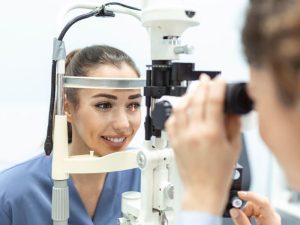
The only way to know your corneal thickness is a measurement called pachymetry, performed during a consultation. This is one of the key tests we describe in What to Expect During Your LASIK Consultation, and it’s a routine part of assessing candidacy for any laser procedure.
PRK delivers comparable results
It’s worth emphasizing, because it’s the part patients most want to hear: choosing PRK because of thin corneas does not mean settling for a lesser outcome. For well-selected patients, PRK’s final visual results are comparable to LASIK’s. The main difference is the recovery experience — PRK heals more gradually and involves more discomfort in the first few days, as detailed in our PRK recovery week-by-week guide. The end result, however, is excellent.
So the trade-off for someone with thin corneas isn’t “great vision versus compromised vision.” It’s “fast recovery versus a slightly longer recovery, with comparable final results.” For most people, that’s a very acceptable trade in exchange for a safe, effective procedure.
Thin corneas aren’t the only reason to choose PRK
While thin corneas are one of the most common reasons PRK is recommended, they’re not the only one. PRK’s flapless design offers advantages in several other situations:
- Contact-sport athletes and very active people. With no flap, there’s no flap to be concerned about during high-impact activity — a meaningful reassurance for boxers, martial artists, and others in contact sports.
- Certain professions where the possibility of flap-related issues is a concern.
- Some corneal surface characteristics that make a surface procedure the safer or more suitable choice.
- Custom and touch-free options. PRK is the basis for advanced techniques like Custom PRK and touch-free TransPRK (TSA).
In other words, being steered toward PRK is often a sign that your surgeon is choosing the right tool for your eyes — not a consolation prize.
What if PRK isn’t ideal either?
Occasionally, corneal thickness or other factors make even PRK less suitable — for example, with very high prescriptions. In those cases, a lens-based procedure may be the answer. An Implantable Collamer Lens (ICL) places a corrective lens inside the eye without removing corneal tissue at all, making it an excellent option for higher prescriptions or corneas that aren’t well suited to laser reshaping. This is exactly why a full assessment matters: it identifies the safest, most effective path from the full range of options. Our complete guide to vision correction options in Calgary lays them all out.
The bottom line
Being told your corneas are thin is not the end of your vision-correction journey — it’s simply a signpost. For many people, PRK offers a safe, proven, flap-free route to the same clear vision LASIK provides, with only a more gradual recovery to account for. And where PRK isn’t ideal, other excellent options remain. The message is consistent: thin corneas rarely mean “no” — they usually just mean “a different yes.” Neutral references like the U.S. FDA’s refractive surgery program and the Canadian Ophthalmological Society can help you understand the options.
How thin is “too thin”?
Patients often want a simple number — a threshold below which LASIK is off the table. The reality is more nuanced. There’s no single universal cutoff that applies to everyone, because corneal thickness is only one part of the equation. Your surgeon considers your thickness alongside your prescription strength (stronger corrections remove more tissue), your corneal shape and topography, and the amount of tissue that must remain for long-term stability. Two people with the same corneal thickness might get different recommendations because their prescriptions differ.
This is why a precise, individualized assessment matters far more than any rule of thumb. The measurement itself — pachymetry — is quick and painless, but interpreting it correctly, in the context of everything else about your eyes, is where a surgeon’s judgment comes in. The best next step is never to guess from an online threshold, but to get your corneas measured and let a surgeon interpret the full picture for you.
Don’t let the word “thin” worry you
It’s worth saying plainly: having thin corneas is not a flaw, a disease, or a reason for concern about your eye health. It’s simply a normal anatomical variation, like having a particular height or shoe size. It doesn’t mean your eyes are weak or that you’re at greater risk in daily life. All it means is that, if you choose laser vision correction, a surface procedure like PRK may be the safer, more suitable route than LASIK.
Many patients feel a wave of disappointment when they first hear “your corneas are too thin for LASIK,” assuming it rules out vision correction entirely. In reality, it’s usually just redirecting you to a procedure that fits your eyes better — often with results every bit as good. Reframing “thin corneas” from a problem into a simple routing factor is one of the most reassuring shifts a patient can make, and it’s usually the moment the whole decision starts to feel manageable again.
Frequently asked questions
Can I have laser eye surgery with thin corneas? Often, yes. PRK is frequently the preferred choice for thinner corneas because it creates no flap and preserves more corneal tissue. A consultation confirms what’s safe for your eyes.
Why is PRK better than LASIK for thin corneas? LASIK requires a corneal flap, which uses part of the cornea’s thickness. PRK creates no flap, preserving more tissue for the correction — making it safer when thickness is limited.
Will my results be worse with PRK? No. For well-selected patients, PRK’s final results are comparable to LASIK. The difference is a more gradual recovery, not the end outcome.
How do I find out how thick my corneas are? A painless measurement called pachymetry, performed during your consultation, determines your corneal thickness.
What if my corneas are too thin even for PRK? A lens-based procedure such as an Implantable Collamer Lens (ICL) may be ideal, since it corrects vision without removing corneal tissue. Your surgeon will advise. The reassuring point is that some safe, effective route to clearer vision almost always remains.
Find out which procedure fits your corneas
Thin corneas don’t have to stand between you and clear vision. For most people, a thinner cornea is simply a signpost toward the right procedure, not a barrier to clear vision. Book a consultation with Clarity Laser Vision in Calgary for a precise corneal assessment and an honest recommendation on whether PRK — or another procedure — is right for you.
This article is for general educational purposes and does not constitute medical advice. Only a qualified eye surgeon can determine the right procedure for you after a complete examination.